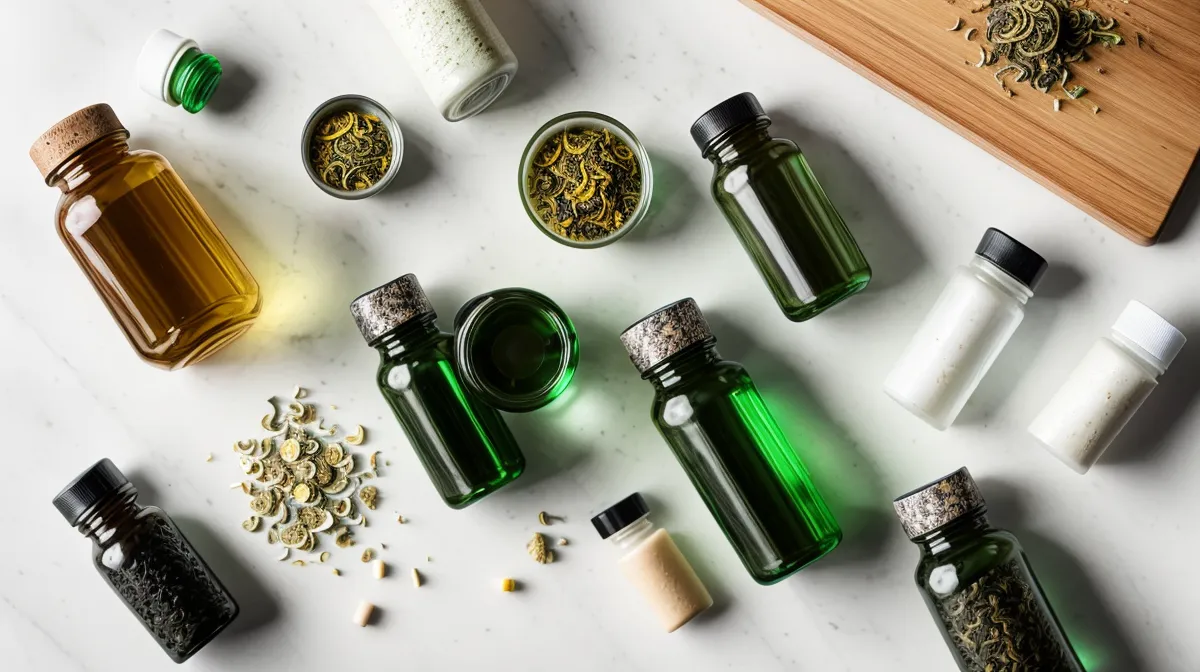
A bottle that lists "green tea extract" on the front and a bottle that discloses "270 mg EGCG" are not the same purchase, even when they're sitting on the same shelf for the same price. That's the myth nobody questions until a health scare or a disappointing checkup sends them squinting at labels for the first time: if an ingredient is named, you must be getting enough of it to matter. You're not, necessarily. Proprietary blends exist so a company can name-drop the good stuff — including SE Asian extracts like ginger and green tea — while burying the actual dose so deep you'd need a lab to find it. Ingredient transparency isn't a bonus feature on a weight loss supplement. It's the only thing that tells you whether you paid for medicine or for a rumor of medicine, and six years of buying, testing, and mostly regretting supplements has made me insufferable about it at dinner parties.
Three months of Costco garcinia cambogia capsules taught me that lesson the expensive way — taken exactly as directed, tracked on a spreadsheet, and good for nothing but a lighter wallet. Years later I fell for the same trick again with a ninety-dollar bottle called "Metabolism Complex," which promised big things and delivered only a "proprietary blend" total with no breakdown of what was actually inside. That same sleight of hand shows up on the shelf at People's Food Co-op on SE 21st Avenue just as often as it does anywhere else, especially with ingredients that genuinely work when dosed properly, like Berberine. Brands love printing it on the front of the label because people recognize the name. What they skip is telling you it's dosed at a fraction of what the research behind it actually used.
Naming an Ingredient Isn't the Same as Dosing It
Here's the correction worth remembering: an ingredient list only tells you what's in the bottle, never how much of it is doing anything. The regulatory loophole that makes this legal is its own long story, one I've picked apart in detail elsewhere, so I won't rehash the whole mechanism here — the short version is that a single blend total can hide almost any ratio behind one number. It's the label equivalent of a recipe card that just says "spices" instead of listing cumin, paprika, and salt separately — technically honest, completely useless if you're trying to actually cook the dish. I also keep a running cost-per-serving comparison for every supplement I test, though that math deserves its own post rather than a paragraph tacked onto this one.
Why Do SE Asian Extracts Keep Ending Up in Blends?
Southeast Asian botanicals get this treatment constantly, and it's not an accident. Ginger, green tea, turmeric — these are ingredients people already trust because they show up in actual food and in traditional remedies that predate any marketing department by centuries. Burying a real Southeast Asian extract inside a blend lets a brand borrow that built-in trust without paying for an effective dose of it. I've gone deep on the traditional remedies I picked up while traveling around Southeast Asia, and that's its own conversation entirely — but the short of it is that raw, single-ingredient versions of these plants got used at doses nobody bothered to hide, because there was nothing to hide them in.
If you're the type who wants a shortlist instead of a rabbit hole, I've put together the best natural appetite suppressants without stimulants or blends for people whose hearts, like mine, don't need any extra help racing at two in the afternoon.
The One Number I Actually Check Now
EGCG is the compound that actually changed how I shop the supplement aisle, and it comes down to one enzyme. EGCG, short for epigallocatechin gallate, is the active compound in green tea extract, and it works largely by blocking an enzyme called COMT, which normally clears norepinephrine out of your system fast. Slow that clearance down and the signal telling your body to burn fuel sticks around longer. The clinical studies that actually found a meaningful fat-oxidation effect from this used somewhere between 270 and 600 milligrams of EGCG a day. That's the number I look for now — not "green tea extract" floating somewhere inside a 200-milligram blend total, but an actual milligram count I can hold up against that range. A friend of mine brews kombucha in a crock on his kitchen counter and has his own theory about gut bacteria and weight loss, which is a fascinating rabbit hole I'll let him defend on his own time. Mine stays narrower: does the label actually tell me what I'm swallowing.
The only proof I've got that any of this mattered is embarrassingly unscientific — I tucked my shirt into my waistband without holding my stomach in, something that hadn't happened in two years, and it stuck with me more than any lab number would have. That's not a clinical result. It's just the kind of detail that makes you trust your own label-reading over a bottle promising big things without ever showing its math.
Stop Reading Ingredient Names. Start Reading Milligrams.
This isn't only a supplement-aisle problem, either — the same shell game shows up in the smoothie-diet world, where a "proprietary greens blend" can mean anything from a real dose of spinach powder to a pinch of parsley dust, and that comparison deserves its own post rather than a detour here. Label-reading like this has basically become the hobby I never asked for, the same instinct that had me picking apart a LeanBiome buying guide ingredient by ingredient instead of just trusting the bottle's promises.
So here's the rule I'd hand anyone standing in the supplement aisle at People's Food Co-op with a health scare behind them and a skeptical eye: flip the bottle over, and if an ingredient you recognize is sitting inside a blend with one combined number instead of its own milligram count, assume you're getting the smallest legal pinch of it rather than a dose that matches the research behind it. It isn't complicated and it isn't mysterious. It's just refusing to hand over ninety dollars on the strength of a company's confidence that you won't ask questions.
All opinions and observations on this site are my own and are shared purely for informational purposes. They do not constitute professional medical, financial, or legal advice. Please consult the relevant professional before acting on any information presented here.
All opinions and observations on this site are my own and are shared purely for informational purposes. They do not constitute professional medical, financial, or legal advice. Please consult the relevant professional before acting on any information presented here.